





Retaining Walls
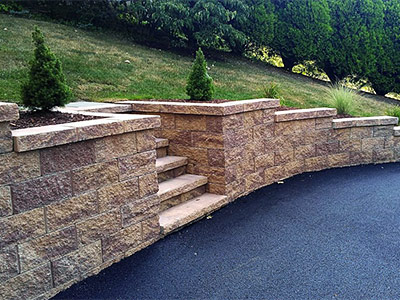 In North Jersey, retaining walls are rarely decorative alone - they are structural solutions to real site problems. Sloped yards, clay-heavy soils, poor drainage, and freeze-thaw cycles place constant pressure on outdoor structures. When a retaining wall is improperly designed or installed, failure is often only a matter of time.
At Ken Steenstra Landscaping, we design and build retaining walls specifically for the terrain challenges found throughout North Jersey. Our approach focuses on stability, drainage control, and long-term performance - not shortcuts or surface-level construction. Whether you need a new retaining wall or are dealing with an existing wall that's leaning, cracking, or collapsing, our process is engineered to address the root causes of failure.
When a Retaining Wall Is Necessary - Not Optional
Many homeowners contact us after problems have already started. In reality, a retaining wall is often required when:- Soil is shifting or eroding on sloped property
- Yard grading sends water toward the home or foundation
- Existing walls are leaning, bowing, or cracking
- Landscape areas are unusable due to steep elevation changes
- Driveways, patios, or walkways are settling unevenly
Structural vs. Decorative Retaining Walls: What's the Difference?
Not all retaining walls serve the same purpose, and confusing the two is a common cause of failure.Structural retaining walls are designed to hold back soil and resist lateral pressure. These walls require engineered base preparation, drainage systems, reinforcement, and height-specific construction methods. Most North Jersey retaining walls fall into this category due to slope and soil conditions.
Decorative retaining walls are typically low-profile and used for visual definition - such as edging planting beds or creating minor elevation changes. While still requiring proper installation, they do not carry the same load-bearing demands as structural walls.
Our team evaluates whether your wall is purely decorative or structurally necessary - and designs it accordingly. Treating a structural wall like a decorative feature is one of the most common reasons walls fail within just a few years.
Why Retaining Walls Fail in North Jersey
Retaining wall failure is rarely caused by materials alone. In most cases, failure results from poor planning or shortcuts during installation. Common retaining wall problems we see include:- Leaning or bowing walls due to improper base depth or lack of reinforcement
- Cracking or block separation caused by uneven compaction or excessive wall height
- Soil erosion behind the wall from missing or clogged drainage systems
- Water buildup and hydrostatic pressure pushing the wall outward
- Freeze-thaw damage when water is trapped behind the wall and expands during winter
How We Engineer and Build Retaining Walls That Last
Our retaining wall process is designed to eliminate the most common causes of failure. Every wall is built with durability and site conditions in mind.1. Site Evaluation & Wall Planning
We evaluate soil composition, slope grade, water flow, and surrounding structures. Wall height, load requirements, and drainage needs are determined before construction begins.
2. Excavation & Base Preparation
A deep, level trench is excavated to accommodate proper base depth. A compacted stone base is installed to prevent settling and uneven movement.
3. Drainage Installation
Drainage stone and perforated drain pipe are placed behind the wall to relieve water pressure. Proper drainage is essential in North Jersey and never optional.
4. Wall Installation & Reinforcement
Blocks or stone are installed level and aligned, with reinforcement added as wall height increases. Geogrid reinforcement is used when necessary to anchor the wall into the surrounding soil.
5. Backfill & Compaction
Backfill material is added in controlled lifts and compacted to reduce future settling. This step directly impacts wall stability and lifespan.
6. Final Grading & Water Management
The surrounding area is graded to direct surface water away from the wall, preventing erosion and saturation behind the structure.
Retaining Wall Repair & Replacement Services
If you already have a failing retaining wall, patch repairs are often not enough. Leaning or cracked walls usually indicate deeper structural or drainage issues. We provide honest evaluations to determine whether repair is feasible or full replacement is the safer long-term solution.Addressing the underlying cause - not just the visible damage - is critical to preventing repeat failure.
Built for Performance, Not Shortcuts
Retaining walls are long-term structural investments. Proper height limits, reinforcement, drainage, and soil preparation determine whether a wall lasts five years or fifty. Our work is guided by site conditions, not generic templates.If you're planning a new retaining wall, replacing a failing one, or trying to understand why an existing wall is failing, Ken Steenstra Landscaping provides practical solutions built specifically for North Jersey landscapes.